A service, not a product
You are buying monitoring on a contract, not a box off a shelf. Two years is the usual minimum, and the equipment is often paid off separately.
Home alarms guide for expats
 By Linus Palmqvist, Head of Operations Reviewed by Simon Nilsson Last reviewed
 Six companies cover most of the country, and they differ more than their adverts suggest. Here is how the market works, what separates one from another, and how to get set up in English.
Free to use · Independent comparison · Help in English

Alarms here are sold as a monitored service rather than a one-off purchase. A monitoring centre sits behind each company, the contract usually runs for two years, and what really separates the options is the service around the alarm rather than the sensors on the wall.
You are buying monitoring on a contract, not a box off a shelf. Two years is the usual minimum, and the equipment is often paid off separately.
Verisure, Movistar Prosegur, Sector Alarm, ADT, SICOR and SEGURMA. The brand on the van is not always the company on the contract.
No company publishes reliable street-level coverage. Rural properties and the smaller islands need checking rather than assuming.
You can do all of this yourself. If you would rather not, we read the quotes with you, check who is behind each offer and set up the ones we can arrange, in English.
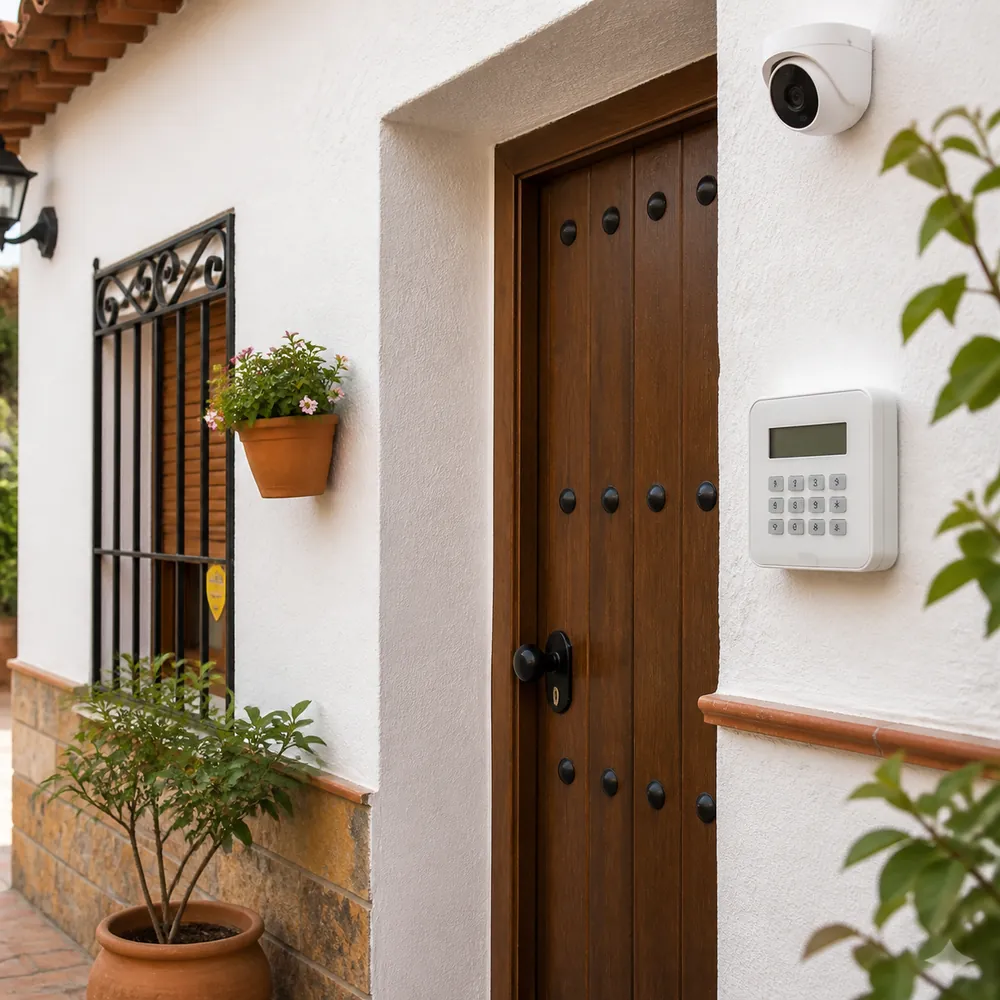
We go through the quotes with you, check who you would actually be contracting with, and set up the ones we can arrange in English.
Five things are worth comparing. None of them is the monthly figure on its own.
Almost every offer opens at a promotional rate and then steps up. The number worth comparing is the total across the full term, including the equipment, not the figure in the advert.
Monitoring and someone coming to the property are separate services. A guard response and key custody are often optional extras, and where they are included the visit is usually an exterior check.
A monitoring centre has to confirm an event before the police treat it as a priority, and how it confirms changes the speed. A camera or audio check is quicker than sending someone to look. Ask which method your system would use.
Several companies have English websites and apps. None of them promises an English-speaking operator at the monitoring centre, which is the moment it matters most.
If the property sits unoccupied for months, the questions change. Who holds a key, how long the batteries last, and whether the service can be paused at all. None of the six publishes a way to pause it.
Both are legal and both have a place. The difference is who is watching, and what that means when something happens.
A licensed monitoring centre watches the system, confirms what is happening and can pass a confirmed alarm to the police as a priority. Only a company registered with the Ministry of the Interior may install one. It comes with a contract and a monthly fee.
The system alerts you rather than a monitoring centre, and you decide what to do. Cheaper, no contract, and outside the private security rules. You can call 112 yourself like anyone else, but a confirmed police response runs through a licensed centre.
If you are in the flat most of the time and want to know when a window opens, watching it yourself may be enough. If the house stands empty for months and you are in another country, the sums look different.
Only a registered company may install a system connected to a monitoring centre. The register is public and free, so there is no reason to take anyone's word for it.
Not the brand. Ask for the company name that will appear on your contract. SICOR trades as SICOR but contracts as SICOR Alarmas El Corte Ingles, S.L.
The Policia Nacional publishes the list of registered security companies. Search the legal name you were given.
Being listed is not enough on its own. Confirm the company is registered for installation, and if it claims its own monitoring centre, that it is registered for that too.
Both regions run their own registers for companies that only work locally. A small regional installer may be legitimate but listed there rather than nationally.
Spain is stricter here than most people expect, and the advice floating around in English is often wrong. These rules come from the data protection regulator, and they apply to a doorbell camera as much as a full system.
Listed alphabetically. Each guide starts with the company you would be signing with, because the brand and the legal entity are not always the same.

A familiar international name, now sold in Spain by a different company than most guides assume.
Read guide
A Telefonica and Prosegur joint venture, and the company behind the anti-occupation cover people ask about.
Read guide
The company that now owns ADT Spain, running its own monitoring centre in Mijas.
Read guide
The oldest of the six and the only one still independent, running since 1986.
Read guide
Part of the El Corte Ingles group, which is why a lot of people come across it in the first place.
Read guide
The market leader by a wide margin, and the one whose contract structure causes the most confusion.
Read guide
Tell us about the property, documents and language needs. We help compare supported providers, prepare the setup and keep the process understandable. We can help with the rest of your move too: gas, water, internet, home insurance and alarms.
Still have questions?
Written by
Head of Operations at Settlewell
Linus moved from Sweden to Málaga in 2021 and set his own home up here, so most of this he has already done the hard way once. Before Settlewell he spent years at Workwide, the cross-border recruiter that has helped over 10,000 people into jobs abroad, latterly as its Head of Recruitment and Operations. He speaks Spanish, lives in Málaga with his partner, and spends his days on the phone to Spanish providers.
We earn a commission if you set up an alarm through us. It does not change what is on this page. We cannot arrange every company we write about. The comparison is ordered alphabetically, not by what we earn. If a company we cannot arrange suits you better, we will say so. The rules here come from Spanish law and the national register of security companies, not from provider marketing. Where a company does not publish something, we say so rather than filling the gap.
We use cookies to enhance your browsing experience, analyze site traffic, and personalize content. By clicking "Accept", you consent to our use of cookies. You can manage your preferences at any time.